
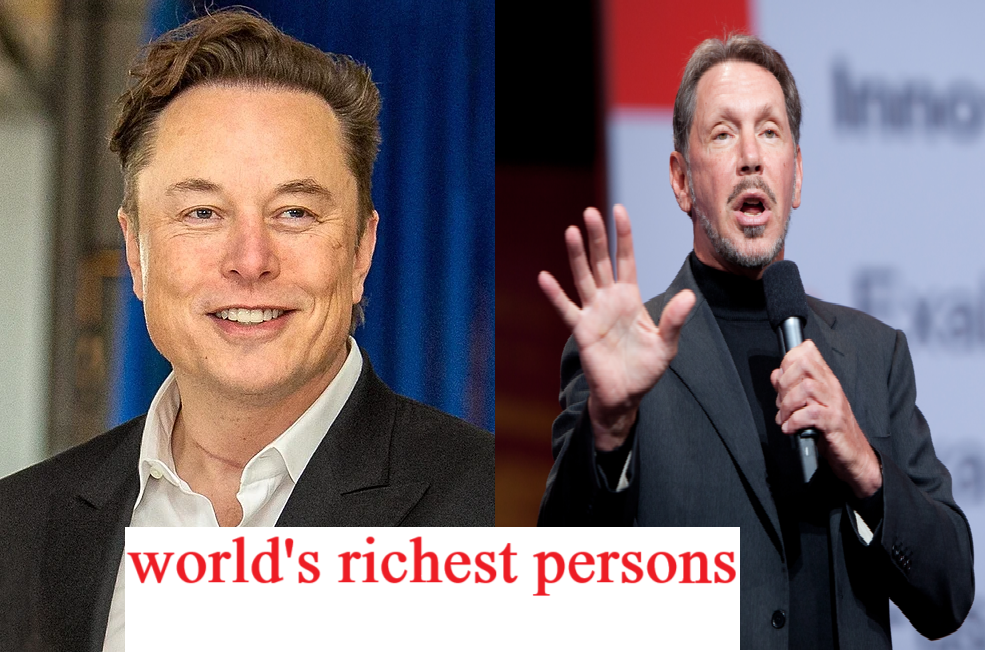
In a dramatic and volatile session that captivated global financial markets, Elon Musk, the visionary CEO behind Tesla and SpaceX, reclaimed his throne as the world’s wealthiest individual. The title was momentarily wrested from his grasp by an unexpected challenger: Larry Ellison, the formidable co-founder of the enterprise software giant Oracle. Ellison’s brief ascent to the pinnacle of global wealth was propelled by a spectacular surge in Oracle’s stock value, a testament to the transformative and value-creating power of the burgeoning artificial intelligence (AI) revolution.
The catalyst for this seismic shift was Oracle’s Larry Ellison’s stunning performance and an overwhelmingly bullish outlook that sent its stock soaring by over 30%. For years, Wall Street had largely categorized Oracle as a legacy tech behemoth, a stable but less dynamic player compared to the high-growth darlings of Silicon Valley. However, the company’s recent earnings report shattered this perception. Oracle demonstrated with resounding clarity that it was not merely participating in the AI boom but was positioning itself as a critical and indispensable pillar of the new AI-powered economy. The company’s robust cloud infrastructure services, particularly Oracle Cloud Infrastructure (OCI), are experiencing explosive demand from companies scrambling to develop and deploy large-scale AI models. This demand for computational power and specialized cloud architecture created a perfect storm for Oracle, leading investors to re-evaluate its future growth trajectory drastically.
This re-evaluation translated into a market frenzy. Oracle’s market capitalization swelled, and in a remarkable display of financial might, the company leapfrogged from its position as the 13th-most valuable company in the prestigious S&P 500 index to the 10th. In this climb, it surpassed a diverse roster of industry titans, including pharmaceutical leader Eli Lilly, retail giant Walmart, and the financial powerhouse JPMorgan Chase. This was more than just a stock rally; it was a fundamental reordering of the corporate hierarchy, signaling a new era where the providers of AI’s foundational infrastructure are being valued on par with the world’s most established and influential corporations.
This corporate ascent had a direct and monumental impact on the personal fortune of Larry Ellison. Having dominated the top spot for an impressive 300 consecutive days, Elon Musk suddenly found his position under threat. As Oracle’s stock climbed throughout the trading day, Ellison’s net worth ballooned at an astonishing rate. Bloomberg’s wealth trackers captured the drama in real-time, at one point highlighting a staggering single-day increase in Ellison’s fortune that catapulted him past Musk. For a brief, shining moment, the fiercely competitive and ambitious Oracle co-founder, a perennial fixture in the top ten but rarely a contender for the absolute top spot, was the richest person on the planet. His ascent was symbolic, representing the immense wealth being generated by the less glamorous but essential “picks and shovels” of the AI gold rush—the databases, servers, and cloud platforms that power the technology.
However, the modern battle for financial supremacy is a volatile affair, waged in real-time and decided by the second-by-second fluctuations of the stock market. Just as Ellison’s reign began, the market’s dynamics began to shift again. The initial euphoria around Oracle’s earnings may have slightly tempered, causing the stock to pare back some of its most extraordinary gains as the trading day neared its close. Simultaneously, the value of Elon Musk’s vast holdings, primarily in Tesla stock, remained relatively stable or experienced a slight uptick. In the rarefied air of mega-billionaires, even a fractional percentage change in the value of a company like Tesla can translate into billions of dollars in personal net worth.
As the closing bell rang, the final tally revealed the razor-thin margin of this epic financial duel. Elon Musk had staged a comeback. His net worth settled at an astounding $384.2 billion. Larry Ellison, despite his monumental single-day gain, closed the day just behind, with a net worth of $383.2 billion. After a day of unprecedented movement, the gap between the world’s two wealthiest individuals was a mere one billion dollars—a rounding error for them, but the deciding factor in a contest watched by the entire world.
This brief but electrifying episode offers profound insights into the current financial landscape. Firstly, it underscores the sheer, unadulterated power of the AI narrative. The market is placing an enormous premium on any company perceived to be a key beneficiary of the AI revolution, capable of reordering long-established corporate hierarchies overnight. Secondly, it highlights the inherent volatility at the apex of global wealth. When fortunes are so heavily concentrated in publicly traded stocks, the title of “world’s wealthiest” is no longer a static crown but a dynamic and ephemeral title, subject to the daily whims and sentiments of the market. Finally, the event adds a fascinating chapter to the relationship between Musk and Ellison, who are not only rivals but also friends, with Ellison serving on Tesla’s board of directors.
In the end, Elon Musk remains on his throne, his position secured by the thinnest of margins. But the gauntlet has been thrown down. Larry Ellison’s brief coup, powered by the unstoppable force of artificial intelligence, serves as a clear signal that the race for the top is more competitive and unpredictable than ever, with the architects of our technological future locked in a continuous battle for supremacy.
