
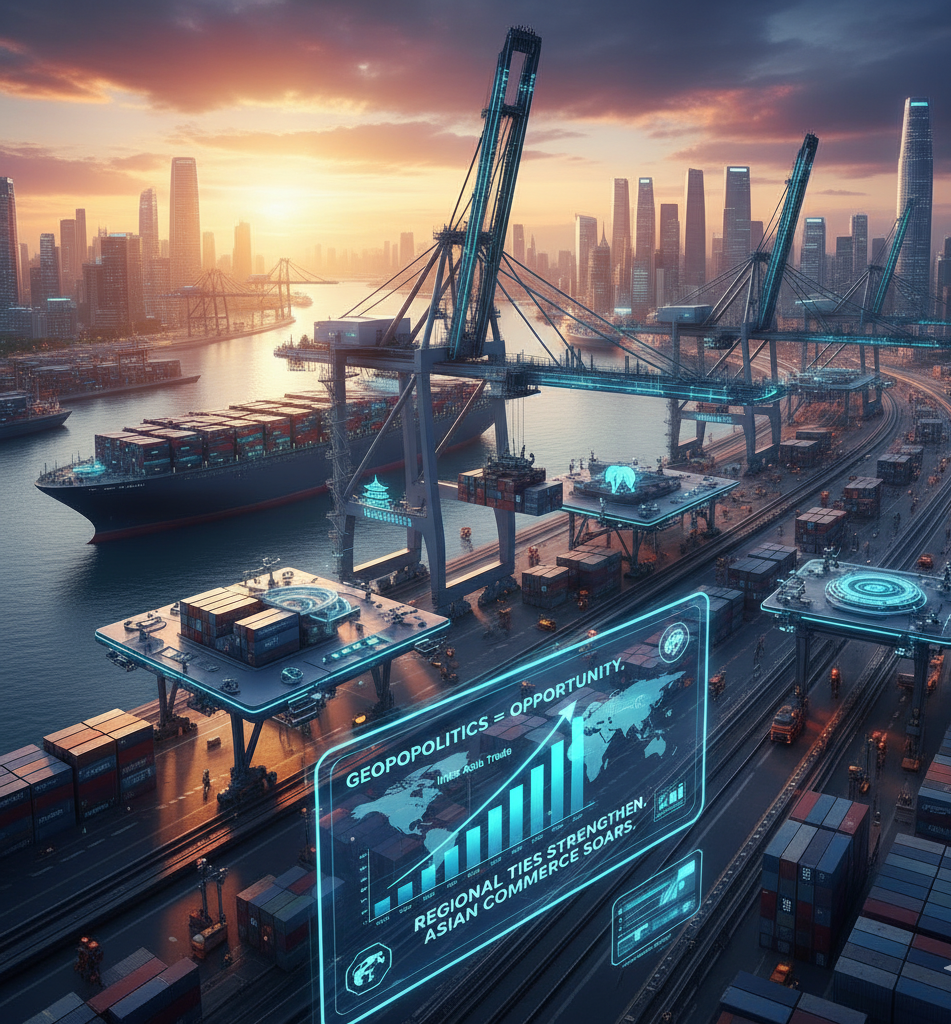
September 12, 2025: The dynamics Indian Economy of India’s trade are changing direction as a result of increases in tariffs by the United States, pandemic-state supply chain breakdowns, and the ideological and geopolitical rift between the United States and China. These changes are strengthening regional ties among neighboring countries and fueling intra-Asia commerce in the context of global uncertainty. Overall, Asian economies are more reliant on each other, and we see more trading occurring between countries in Asia in spite of ongoing global uncertainty.
Changes in Trade Patterns
Indian Economy Asian nations are developing regional connections to provide diversification and lessen reliance on older markets. Association of Southeast Asian Nations (ASEAN) has now become China’s largest trading partner, displacing flat the United States (US) and the European Union (EU). Latest data from the first quarter (Q1) of 2025 shows ASEAN contributed 16.6% to China’s foreign trade, a clear sign this region is not only peaking its importance in global trade.
Indian Economy threatens to stall altogether despite the hurdles still presented by ever higher US tariffs. The United States has raised tariffs by upwards of 50% on export shipments from India, recently showcasing Russia’s purchase of crude oil. This is stifling with a 60-70% reduction on exports of textiles, jewellery, seafood and leather to America where India is still substantially strong.
New winners have emerged.
While those in Indian Economy grapple with tariffs, other Asian economies are seizing this opportunity and coming out on top. Apparel exports from Bangladesh to the US rose to $3 billion between January and April 2025, a 29% increase on a year on year basis. Vietnam on the other hand is attracting new overall international capital to replace companies moving diversifying away from China. This could be a signal of how global tensions are changing trade prospects across the ASEAN region.
Supply Chain
Companies were prompted to shift towards regionalisation of production closer to the source of demand after they confronted the vulnerabilities of global logistics during COVID-19 pandemic. This has favoured Southeast Asia, China, and the Indian Economy. Analysts expect that within five years, more than 15-25% of global merchandise trade will shift geographic location which will serve to further entrench the vital role of Asia as key supply chains.
Currency and Payment Infrastructure
Concurrently and with the growth in trade, Asian countries are strengthening financial ties. ASEAN has rolled out a roadmap for the 2026-2030 period to actively promote the settlement of trade in local currencies, further reducing dependency on the US dollar. Payment digital platforms, such as the PayNow-UPI link between Singapore and India, are in place for seamless on-demand cross-border payment.
